Steven Zimmerman and Ken Bruzenak, students from an MFA Graphic Design course at SCAD, uncovered and recorded stories of innovative material reclamation occurring in Savannah, Georgia. This is the second of three stories.

By Steven Zimmerman and Ken Bruzenak
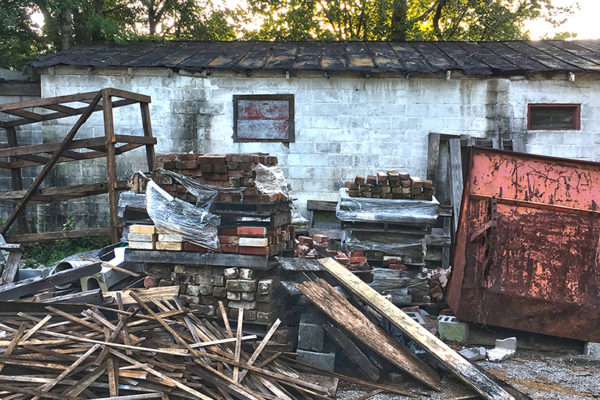
On East 35th Street in Savannah there is a worn and dirty block long building that dates back to 1923. It used to house the hundreds of employees of The Star Laundry, and was once condemned for demolition and the landfill until it was rescued and converted into a warehouse and workspace for salvaging old building materials.
Inside are 18-inch wood beams that span over 30 feet, miles of thick rough sawn boards in 16 foot lengths, oversized ornate roof corbels, and enormous belt-driven saws that were made in 1914 and still work, sometimes. Sawdust and age are everywhere, along with random doorknobs, plaster ceiling medallions, locksets, office chairs, sash weights and other crafted architectural details that just aren’t made anymore.

Also inside are the offices of the Southern Pine Company of Georgia, originally established in 1895, currently being run by owner and president Ramsey Khalidi, a Savannah developer, preservation activist, and a founding board member of Emergent Structures. Khalidi is an exuberant, knowledgeable, grey-bearded child of the 60s, full of his generation’s “Save the Earth” idealism, coupled with the pragmatic skills and resources to follow through on his ambitious goals.

He lives in a large plantation farmhouse built in 1812, which he had cut in half horizontally and moved across town and refurbished with reclaimed materials. “This is the last Savannah River plantation house,” said Ramsey.

The first LEED certified McDonalds, located in the first LEED shopping plaza at Abercorn Commons contains materials supplied by Khalidi. “We installed the large steel beams on the McDonald’s project. They’re willing to do urban stores that conform to the neighborhood, which is big. They are following a resurgence in urbanism, and they have the money to enter the “green” market, to pave the way. The old big box model stores, and the cookie-cutter stores, are finished because their customers are shopping greener. So we now have to pitch to the architects and CEOs of McDonalds and Walgreens and Urban Outfitters about ways to build for a planet of 6 billion people that want to live in a better world.

“Urban Outfitters gets it, they were smart when they came to downtown Savannah on Broughton. We put in a $300,000 shell, and then they came back and put in another $1.9 million with lots of wood and glass and steel. Actually, high end stores are already doing green construction, and they only do it to save money in the long run. They don’t put in drop ceilings and wire mold just to save a few dollars up front.
“Currently, doing reclamation restoration costs more: the materials are not always readily available, people don’t know how to look at a building and see the potential savings of a simple cleanup and repair. Usually the first thing remodelers do is a total demo job, gut everything to the studs, fill the dumpster and fill the landfills. Well, good for you.”

Once started, Ramsey’s enthusiasm gathers speed with crusading zeal. His cluttered office and reception area is filled with plans and books and files, and his stories are full of names ranging from contractors to local government officials to the rich and powerful.
“Marc Jacobs and his architects wanted to keep the patchwork look of the wood and steel, adding car parts and period display cases. They took out walls and stretched the limits of what restoration can be, but the architectural history of the structure all shows on the interior. Right now I’m after Walgreen’s: I want to pitch to their architects and designers and say to them, ‘I want your customers to experience what I feel when I enter a rock-solid historic building. I want them to feel that strength you get with historic materials that will last another hundred years. That feel you get from rich, solid maples and exotic woods you can’t get anymore.’ And WalMart could do a lot more on those giant boxes with solar panels and more glass to save on lighting.

“I’ve been doing this since 1973, when I was working on the factory floor and saw the waste going out the company’s smokestacks. I introduced the idea of heat exchangers to capture the energy, and I’ve been at it ever since, but always in one-on-one meetings, having to explain everything in dollars and cents, over and over.

“Right now we are discussing the Martin Luther King flyover (an old trestle no longer in use that spans Martin Luther King Boulevard) with the city, which we are pitching to keep. I went to the city and said ‘I have a better idea. Why take a perfectly reliable bridge down. We can add a little material and use it as an elevated crosswalk, maybe a 150×80 foot mini-mall.” Khalidi uses New York City’s HighLine as a good case in point. “We can develop it, add some small stores, save the neighborhood and relink the community across a six-lane street.’ But there is an entire project team hellbent on taking it down. When I came in with a Plan B there was some interest, but the lawmakers just wanted to know why I wanted to save an old bridge. My response is that if that is what they thought, then so is Jones Street.
“The problem is that what I was proposing didn’t fit their mind-set. It wasn’t brand-new or something historic from 1890 that I wanted to save. Mid-century is disposable, but at least we’re discussing it because it saves demo money, hands down; it’s sustainable, hands down; it’s preservation, hands down; it has a certain aesthetic value, I think.
“Part of the struggle is just about breaking habits. Some very educated, professional, powerful people have bad habits and a resistance to change. They have more reasons NOT to do things than you can think of. Then there are regulations and inspection rules that mandate new materials for no valid reason. The wood needs an Underwriters Laboratory stamp like at Lowes, even though the heart pine is much stronger, better, and historically correct. Architects and designers occasionally push for green policy now, but they will always back off if the client thoughtlessly insists on shiny and new. There are lots of impediments, but mostly it is the assumption that newer is always better.”

Ramsey’s plans for the future are ambitious, and he relentlessly pursues opportunities to evangelize for repurposing old materials wherever he can. A series of massive planters, over 20 feet long, are beginning to appear throughout Savannah, assembled with recovered lumber in Ramsey’s workshop. He was involved in several of the Broughton St. refurbishments, and the underground garage and park at Ellis Square.
“I’ll take on anything: small steps to create working models and sell ideas. I’d love to do something like the Power Plant in Baltimore, a giant industrial structure, half-a-dozen floors high, with shops, restaurants and a Barnes and Noble bookstore. But I got a call from Goodwill recently about working on a program to get homeless veterans off the streets. They say there may be as many as 4000 vets out there, and Goodwill is interested in a work training program.
“My ultimate goal is to make a better world, with universal healthcare, housing, a job and kids if they want, but we aren’t there yet. And we need to get through to the people who think a family of three in a 15,000 square foot house is green just because they installed a recycled floor in the kitchen. The Europeans are far ahead of us on this because they have always had to live within their available resources. Americans have always had abundance, Manifest Destiny, and acres of redwoods over the horizon.”

“Right now, one of my peeves is that Savannah recycling is only for residential pickup, not businesses. I had to pitch that there were once houses on this block, pre-1923, just to get recycling cans. There are lots of businesses in this town that don’t recycle, and I don’t want to get into the food waste from restaurants.
“I’m afraid we need some sort of government mandate, at least at the beginning, to demand a certain percentage of recoverable deconstruction, and require a certain percentage of reclaimed materials in new construction. If you mandate it, people will get creative and you’ll see more green thinking. And maybe it starts with the non-profits until the for-profit companies feel the competition.
“Meanwhile, I’ll be the guy going around the city asking ‘Why are you throwing that shit out? It’s still good, and somebody can use it.’”