By Nick Stratton
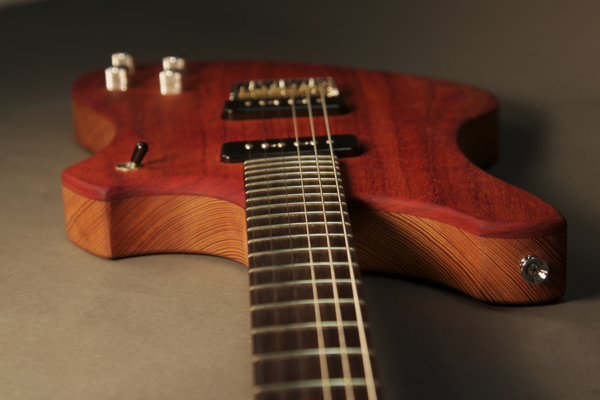
For my Industrial Design senior project at SCAD, I wanted to build a guitar. However, the project needed more depth; after all good design has to solve a problem. I needed to find a problem to solve, a way to solve it, and a market for my product. Having recently taken a sustainability class with Professor Scott Boylston, my first instinct was to look into designing a “green” guitar: one that didn’t harm the environment and was ultimately a sustainable alternative to what was currently on the guitar market.
My first thought and initial research was in new materials, since guitars are made mostly from wood, as well as some small amounts of metal and plastic. I tried to first research ways to make a guitar without using one of earth’s finite resources (in my research I found that the guitar industry uses about 200 different wood types, 35% of which are severely endangered). However, after exhaustive research I found that though several attempts at making a guitar out of other materials had been attempted (several companies had designs made from recycled plastics, wood pulp/plastic composites, etc.) all had been miserable failures, due to the simple fact that these materials couldn’t match the look, feel, and most importantly the tonal properties of a traditional wooden guitar.
I had to take a step back and reevaluate my problem. This is what I discovered: the problem wasn’t in the guitars themselves as objects. In fact, despite what it’s made from a guitar is inherently a sustainable object. Why? Because they just aren’t thrown away. A single guitar (especially a high quality one) will last decades. People just don’t throw them away, they are valued and passed down and repaired and rebuilt and rarely make it to a landfill. Even after a guitar has no ability to be played again most end up as wall decorations or art pieces.
As such, the real problem is in their manufacture.
Large guitar companies continue to import irresponsibly harvested wood from all over the world. Their cutting methods are wasteful (board cut-offs from rare wood types are often thrown away when they could be used as inlay material, knobs, or acoustic guitar bridges), and they continue to use harsh chemical finishes.
So, my plan was to create my own guitar design and build it sustainably to show that a guitar made in a sustainable manner could be as beautiful, and tonally desirable as one manufactured by the big companies.
I started by sourcing the wood for my guitar.
For the sake of the project, if this sustainable manufacturing were adopted by the big companies the best option for wood sourcing would be to go with FSC certified wood. Most of the species commonly used in guitar building are available in large quantities from responsible harvesters. However, for the guitar I was building, I wanted something a little more special. In luthiery (the art of guitar-making) it is generally accepted that the older your tone woods are, the better your instrument will sound (this is a big part of the reason vintage guitars from the 50’s and 60’s boast such huge price tags today). This is because newly harvested wood; even after being kiln-dried, is filled with resins (essentially the glue that holds the wood fibers together). Kiln drying causes these resins to become stable enough to cut and glue the wood. However, in the same wood; allowed to air dry for a few decades, these resins become crystallized, making the wood extremely stable and extremely resonant. This increased resonance means increased note sustain and harmonics in the finished instrument.
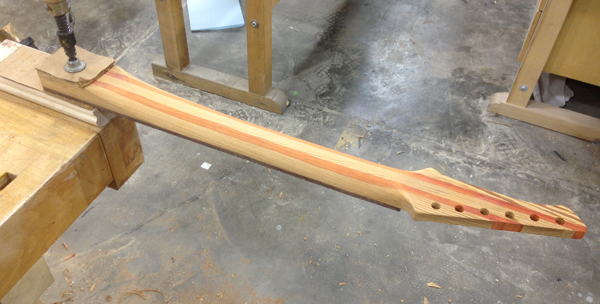
To achieve this, and also meet my sustainability goal for the project, I sourced a piece of reclaimed old-growth Savannah heart pine for the body and neck of the guitar from Ramsey Khalidi at Southern Pine Company in downtown Savannah. Now, many of the guitarists and guitar builders reading this may be saying to themselves “pine? For a guitar body?” because for most people, pine is thought of mostly in its construction grade form (the 2x4s you buy down at home depot known for twisting and warping before you even get them home.)
However, the piece of pine I chose was once used as a massive rafter beam in a historic downtown Savannah building. The building was built in 1780 and the rafter was removed when the building was remodeled into a restaurant a few years ago. So, assuming the wood was harvested the same year the building was constructed, the piece I chose is at least 230 years old. How’s that for vintage!
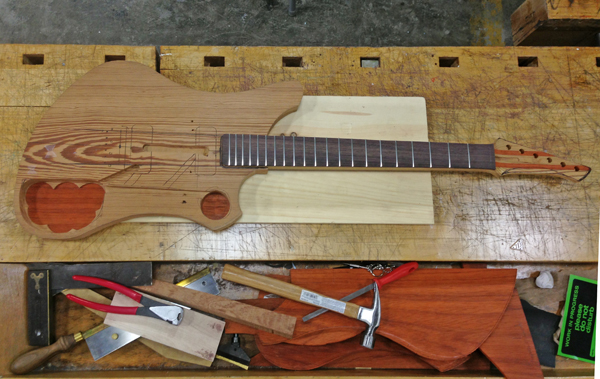
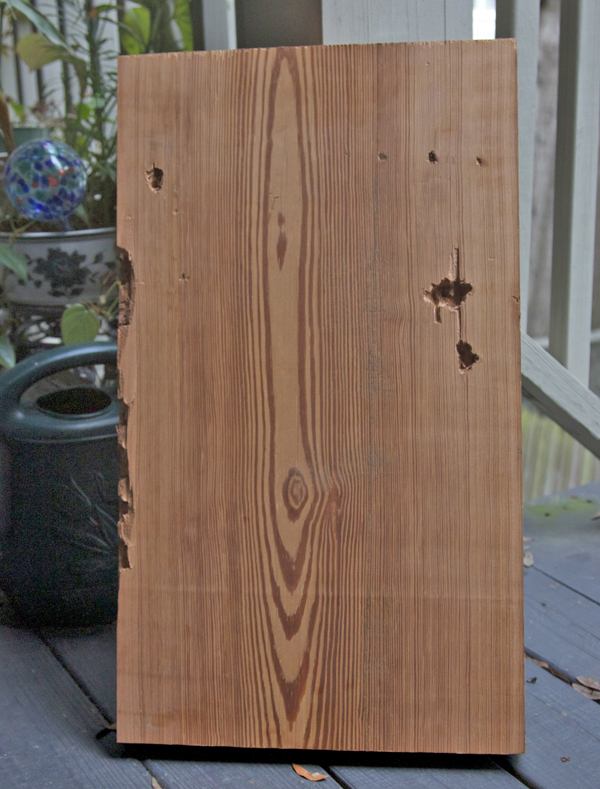
Being this old, the resins in the wood were completely crystallized making the wood extremely stable and super resonant, yet the wood had retained enough moisture (due to Savannahs humid climate) to not completely dry out and begin splitting. The piece I chose was littered with nails (if you look at the picture of the original piece you can see the deep holes in the body from having to dig them out. However, after removing them I was able to get my body shape out of the single piece and still have enough wood left for the neck as well (it’s extremely common for guitar bodies to be made of 2 or 3 pieces glued up together). A single piece body meant less chemicals needed to glue the guitar together, as well as increased sustain (the length of time a note will vibrate through the guitar and produce a sound).
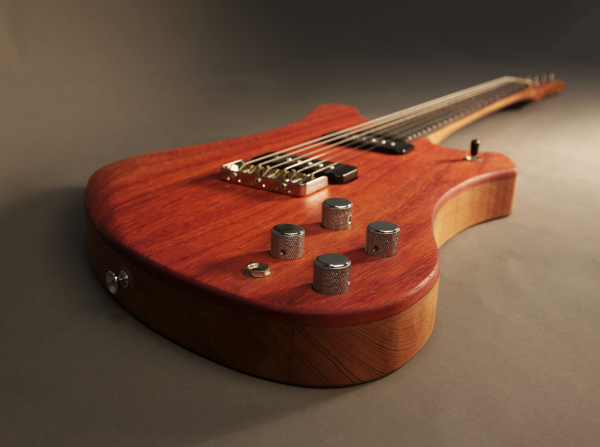
For the fretboard (the playing surface of the neck) I chose a piece of reclaimed katalox that I got from a local wood shop that had a few pieces that were too small for their furniture projects, but perfect for what I needed. Katalox is wonderful because visually it is indistinguishable from rosewood (the most commonly used fretboard wood used in the guitar industry, which also happens to be extremely endangered). However it is much denser and harder than rosewood, closer in fact to ebony, which is why many refer to katalox as “Mexican ebony”. And lastly, for the neck laminations and the book matched top of the guitar, I chose a piece of padauk. Padauk is an interesting wood; it has a really intense rust orange color when you cut into it or sand it, which oxidizes to a gorgeous reddish brown, similar to the color in the grain of the antique heart pine. Despite its exotic color and name, it’s actually most commonly used as shipping crate material in Europe and Africa.
In an effort to be as sustainable as possible, I did as much of the work on this guitar by hand as possible. Due to the 10 week time limit I had to design and build the entire guitar, I admit to using the band saw and surface planer to true up the wood and cut out the body shape.
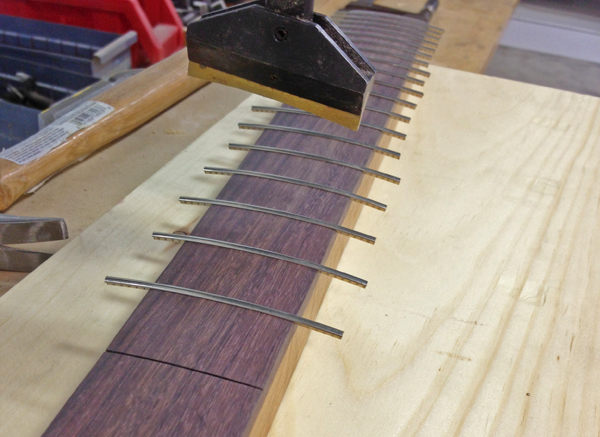
However, most of the work usually done by CNC: radiusing the fretboard, cutting the fret slots, carving the neck profile, and shaping the headstock; I did by hand using traditional hand tools. All cut-offs and scrap from the project was either saved to use as inlay material or given to other students and made into other projects. I also chose to use a bolt on neck joint, which minimized the glue needed to build the guitar. This sustainability goal was carried on into the finish of the guitar as well.
In the guitar industry, the most common finishes are polyurethane and nitrocellulose lacquer. Both are quite different from each other, however what they share is high toxicity; they are both really nasty and dangerous chemicals that I really wanted to avoid using. So in substitution I decided to finish my guitar with a natural oil finish, which while being a lot less toxic, also brings out the gorgeous color and grain of the woods I chose. This finish also lets the wood breathe and resonate freely where a poly finish essentially acts as a hard plastic shell over the guitar that deadens the vibrations a bit.
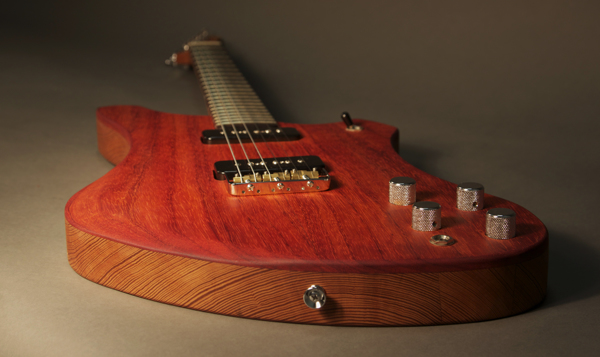
To meet the expectations of my market, I sourced high quality electronics components and pickups for the guitar. The pickups are p90’s hand wound in Washington state by Lollar Pickups. The electronics components were hand wired by Emerson Custom Electronics using vintage spec paper-in-oil capacitors and US made CTS potentiometers, switch and input jack. These pickups and components are wonderful because, they work in conjunction with the wood to amplify the natural tone of the guitar; and what a tone it is! This guitar sounds phenomenal; I am so excited with how it turned out. The heart pine/katalox/padauk combination produces a big powerful tone with strong booming lows, singing highs, and rounded but present mids. The sound is warm but always articulate, never getting too muddy even when the volume is dialed back. And then there’s the sustain, when you pluck a note or strum a chord on this guitar it just rings out strong and clear for days!
Overall, I think this project was a great success. I’m really proud of the outcome and the guitar sounds so much better than I ever anticipated. I was able to complete a boutique quality guitar, built with sustainable and reclaimed materials, without using harsh chemicals and with a minimal amount of energy use from power tools; proving that it is indeed possible to build a truly sustainable guitar.