
-
Installed, and ready for service!
Aug 19, 2012 | Collaborators, Exclaim Your Reclaim, Savannah Gardens Today No comments yetBy Scott Boylston

The Savannah Garden rain barrel stands are installed and doing their job! A year ago the studs that now hold up these rain barrels were in the walls of the old buildings on site.
Thanks again goes to Charisse Bennett as the Emergent Structures project manager, and Garrison Marr, Director of Sustainability for the City of Savannah’s Housing Department. Thanks, too, to all of the resident of Savannah Gardens who came out to the workshop!
Nineteen rain barrel stands for 19 Earth Craft single family homes!


-
SUBMIT A PROPOSAL: Public Art at Savannah Gardens!
Jun 29, 2012 | Collaborators, Exclaim Your Reclaim, Savannah Gardens Today 1 Comment »
By Scott Boylston | image courtesy of Thomas & Hutton
We are immensely pleased to announce the City of Savannah is accepting proposals from qualified artists to design, produce, and install a public art piece in Savannah Gardens that is made, at least in part, of reclaimed materials!
The City of Savannah has a maximum budget of $25,000 for the design, production and installation of this public art piece. As a part of the requirements, the artwork must be produced in partnership with neighborhood residents. The Savannah Gardens redevelopment is a CHSA project in partnership with the City of Savannah.
As far back as August 2009—after the very first visits to the old Strathmore Estates—the founders of Emergent Structures have been advocating for public art that makes use of reclaimed materials from the site as a means of celebrating the area’s history. And now we are thrilled to see this project get started!
Savannah-area artists, let’s see what you’ve got!
___________________________________
TUESDAY, JULY 3rd at 10:00 am | PRE-BID CONFERENCE
Savannah Civic Center, 301 W. Oglethrope Ave.
This is an information session only—no submittal materials are due at this time, but all who are interested in submitting a proposal MUST be in attendance!
___________________________________
TUESDAY, JULY 10th | PROPOSALS ARE DUE
___________________________________
Below are some of the criteria, but for those interested, we suggest you visit the URL, and download the complete description AS SOON AS POSSIBLE!!!!!
___________________________________
4.2 Design Criteria:
While the final product will be an collaboration between the selected artist and neighborhood residents, there are several design criteria that create parameters for the public art piece:RECLAIMED MATERIALS: The final piece of art will incorporate reclaimed materials from demolished structures that used to stand in the Savannah Gardens neighborhood. These materials currently include 6 slate chalkboards, approximately 8 square feet of 2″ granite slabs, floral design concrete bench anchors, and 5′ aluminum letters that spell “Pennsylvania Avenue School” from the Pennsylvania Avenue School. It is anticipated that additional reclaimed material could become available as re-development proceeds. While not all materials must be used, it is desired that the final art piece utilize as much reclaimed material as practical and appropriate.
ART SITE: The site of the public art installation will be located in a 13’4″x 13’4″ area with a perimeter of masonry seat wall along a pedestrian plaza in Savannah Gardens. This space will have brick pavers at grade until an installation is made. The site is adjacent to what will be a spray fountain, retail and multi-family housing, and a Chatham Area Transit bus stop. The attached Exhibit A is a site plan that includes the pedestrian plaza.
Collaboration with neighborhood residents: The selected artist must meaningfully engage with neighborhood residents and provide an opportunity to inform the final design, as well as observe or otherwise experience the production process.
DURABILITY: The final design must be sufficiently durable for an outdoor installation in an area with heavy foot traffic. Final design must include provisions for protecting the art from the weather, including properly sealing all components and articulating anticipated maintenance needs. In addition, the final design must include consideration for properly anchoring the art piece to a foundation, in consultation
with a professional engineer. -
Savannah Gardens Rain Barrel Community Workshop!
Mar 23, 2012 | Collaborators, Exclaim Your Reclaim, Savannah Gardens Today No comments yetBy Charisse Bennett

On Saturday March 10th, all 19 rain barrel stands were assembled and painted by a wonderful group of volunteers ranging in age from 5 years old to 55+ (just a little guesstimate on my part). With tremendous help from Garrison Marr, Sustainable Development Coordinator for the City of Savannah and other intrepid staff from the City of Savannah, Emergent Structures led a community workshop that resulted in rainbarrel stands made from reclaimed materials for the single family, Earth Craft certified homes being completed in the Savannah Gardens redevelopment. The majority of the materials were reclaimed from the housing that only a year ago stood on the very same site as the new homes do now.

We had a great turn out of little helpers just itching to lend a hand. And while we were not at all expecting so many children to show up, their excitement and wonder was contagious. They couldn’t wait to figure out what we were doing and how they could help. While the little hands were much too small for the construction part, they proved to be great painters. So much so, we could hardly keep up the supply of completed stands for their eager brushes.

The construction got off to a bit of a slow start due to the need to describe the the process, and educating individuals on the proper use of power tools. But as the assembly line process ebbed from loss of battery power, everyone took a break to recharge on the delicious food that Thrive Café provided the event. The break helped clear everything up, and a wonderful rhythm was in place as construction continued. The entire event took a little bit longer than anticipated, but the final outcome was all stands were completed and packed up for storage before installation.

Well…completed minus one additional element – the aluminum plinths for installation. These finishing elements weren’t available for attachment on the 10th. I picked them up last week and Garrison Marr and I installed them the other night in no time at all. So NOW they are complete and ready to be installed at the houses. The first 10 stands should be installed next week once the houses are fully complete, with the remaining 9 installed in a couple more weeks. We can’t wait to see them in action!
Thank you, City of Savannah, and thank you Savannah Gardens residents!
-
A Peak at the Rain Barrel Stand Process
Feb 27, 2012 | Collaborators, Savannah Gardens Today No comments yetBy Charisse Bennett

You can buy a table, or you can make a table from raw materials. Or you can do something in between, like buy a partially assembled table, and build it at home yourself. There’s often a great deal of satisfaction associated with constructing parts of a table yourself. You’re released from the arduous tasks of fabricating every single piece, yet you can partake in the act of creation by assembling the table yourself.
The same could be said with Emergent Structure’s community workshop for building rain barrel stands for the Earth Craft houses in Savannah Gardens: Residents will find satisfaction in the act of assembling rain barrel stands (and learn some carpentry tricks along the way) without be confronted with the burden of preparing the materials.
The preparation for these materials began about a year ago, when the studs were reclaimed and denailed from the previous structures on site by volunteers from Emergent Structures and the Girl Scouts of Historic Georgia. While some of the studs have already moved onto various new lives, others have waited patiently until this project came along.
This post reveals a little about the process of prototyping a stand from the available reclaimed materials and then pre-cutting the materials to make the final assembly enjoyable, educational and manageable within a workshop format.

First, the design had to be simple enough that special tools, skills, or processes weren’t required, all the cutting of materials needed to be done beforehand to eliminate additional risks on the day of the event, and the entire construction needed to be of a timely manor so we don’t take up an entire Saturday afternoon. By keeping these requirements in mind, the design you see above is what developed, after an initial trial and error construction.
The construction materials are all reclaimed and a vast majority has been harvested from the previous Savannah Gardens’ houses. The hardware is new, and the stain, while ‘new,’ has been reclaimed from a previous job site.
All the materials were gathered together by Scott Boylston and myself, and then cut down to size with the help of Andrew Carleton. That’s about 250 pieces of wood! They are ready to be hauled to the event site for construction.

The original design used reclaimed bricks form the site to lift the wood off the concrete pad in order to prevent untimely rot. After showing the design to the contractors who are completing the houses, there was one more change. Instead of using bricks for the footing support (image below) they preferred an aluminum plinth to hold the wood off the concrete pad they are including in the installation. While this is new material and an additional cost, it should prolong the life of the stand and therefore prolong the use of the rain barrel.

On the day of the event—MARK IT DOWN, VOLUNTEERS: SATURDAY, MARCH 10th— the materials will be divided into separate stations to create an assembly line of construction. People are invited to chose a station or start at the beginning and follow the process all the way through. This way everyone gets the chance to help exactly how they want. Our friends at Thrive Café will also provide light refreshments to keep everyone energized and refreshed.
-
Rain Barrel Stands for Savannah Gardens!
Feb 20, 2012 | Collaborators, Exclaim Your Reclaim, Savannah Gardens Today 1 Comment »By Charisse Bennett

On March 10th, newly established Savannah Gardens residents will come together for one of their first community events in the new development’s history, and we’re happy to say that it will celebrate the site’s past by incorporating reclaimed materials into a community-based, sustainable design project!
Emergent Structures will be guiding a workshop for the community as they gather together to construct 19 rain barrel stands for the new single-family homes being completed in the next few months. Thanks to the City of Savannah’s Housing Authority, and as a part of the homes’ Earth Craft certification, these buildings will be equipped with rain barrels, providing the residents a free source of water for watering their lawns and gardens. And with much of southern Georgia recently moving from extreme drought to exceptional drought, the need for water conservation measures is becoming increasingly evident.

The stands are being constructed primarily of heart pine wood and brick reclaimed from the previous Savannah Gardens’ houses through past Emergent Structures events, helping keep the history alive with the new and existing residents. The simple structures will help lift the barrel from the ground to allow gravity to feed the water through the hose.
While there are simpler methods for creating a base for the rain barrels (the below image is an early prototype–stay tuned for more on the design process and the final prototype!), this project is about more than that. Having the community construct these stands creates an opportunity for each individual to realize the possible strengths of their neighborhood, a chance to meet others through a structured event, the opportunity to learn a new skill, and the confidence to know that they helped create something of value in their own neighborhood. When people can walk through their own housing development and can point at something that they made with their own hands, that level of ownership can go a long way in building community pride and cohesion.

The key players in completing this project are the City of Savannah Housing Authority, Emergent Structures, and the Savannah Gardens Community Group . Groups that will also be involved include: Construction Apprentice Program students, Savannah High School special education class, and the surrounding neighborhood associations.
-
The Harvest that Keeps on Giving
Jan 21, 2012 | Collaborators, Exclaim Your Reclaim, Savannah Gardens Today No comments yetBy Scott Boylston

In a post from last August on Mercy Housing’s mixed-income redevelopment of Savannah Gardens, we showed you the flooring that was re-purposed from roof sheathing reclaimed from the old buildings on site, and denailed through the efforts of Emergent Structures. Brian Quigley, GC for NorSouth (the lead contractor for this EarthCraft redevelopment project) gave us an updated tour of the nearly complete Phase One.
Along with getting another peak at the two ‘new’ floors—now in full action with the development’s new tenants (the wood floor in the above photo, and the brick floor mentioned in an earlier post)—we got our first look at shelving and cabinets made by Dwayne Larson, owner of Larson Construction. Dwayne, who did all of the work on the above flooring, used more of the reclaimed materials that were reclaimed way back in 2010.
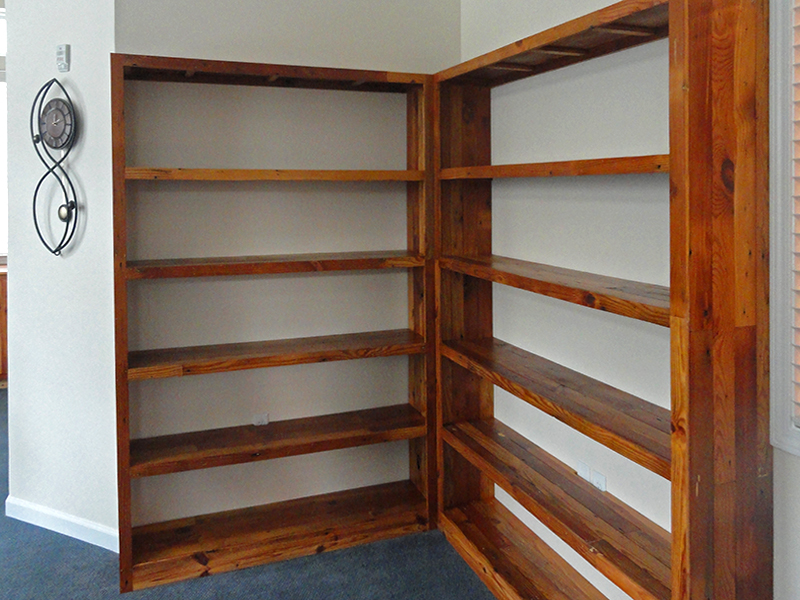
There’s a richness about all of these reclaimed elements that anchors the entire interior of the newly constructed buildings in an undeniable fashion; something that speaks not only of a history, but of a solidity, a security and a warmth.

After showing us these newly installed features, Brian took us over to Phase Two (a senior living building) still under construction, to show us where the next round of reclaimed materials would be installed. The images below are of another communal space, and the main foyer, both of which will be floored with reclaimed roof sheathing. The sheathing for these floors will come from buildings that are being abated as I write this. There are even more features envisioned for Phase Two that are still their early stages, and we’ll report on those at a later date.


-
a solid foundation, in deed
Oct 18, 2011 | Collaborators, Exclaim Your Reclaim, Harvest Events, Savannah Gardens Today No comments yetBy Roger Bowman

As a new member of the Emergent Structure board, my first “real” project came together with my love of ice cream…although it took Director Scott’s post for me to find out how the two were connected.
I was one of the several volunteers who answered the ES call to de-mortar 500 bricks for the lobby of Mercy Housing’s welcome center at the Savannah Gardens redevelopment. It was my first time visiting Savannah Gardens, and it was a quiet Saturday morning—I could almost hear the many voices of the former SG residents echoing across the site.
We quickly set up some work stations and went to work collecting bricks and knocking the mortar off and carefully counting and stacking the bricks ready for reuse.

By work station, I mean a beach chair with a block of cement from a former porch to use as an anvil, and by collecting bricks I mean walking around the site and picking up bricks; and by knocking the mortar off, I mean sitting in the beach chair using the porch/anvil block and a hammer and chisel to separate the 1940′s brick (a beautiful thing) from the 1940′s mortar (a crumbly thing), and repeat. 500 times.
Here’s the thing about a brick; it used to be a clay deposit somewhere until it got dug up, formed into shape, fired in a kiln at a bazillion degrees, trucked into place and carefully assembled into a house capable of withstanding a hurricane. To paraphrase Kevin Costner on the mound with Tim Robbins and the rest of the team in Bull Durham, it’s got a lot of stuff going on. It’s durable, and it’s very, very reusable. The below image is from a color test for the reclaimed bricks, before they were cut in half and laid.

Left behind at the Savannah Gardens demolition, these bricks were on the verge of falling into a take-make-waste model of consumption; take the clay, make the brick, waste the leftovers or discards or at end-of-life. Enter ES and a band of volunteers, and diversion is the result, which is a vast improvement over the old school, consumptive model of production. And these storied old bricks move on to their new life as a story floor in the new welcome center across the street.

In addition to the ice cream connection, I’ll add my playful—or at least confessional—perspective to the morning’s hard work; after my wrist stated to pain me from the de-mortaring part of the work, I shifted over to the count-and-stack part of the operation; I collected the newly cleaned bricks from the de-mortar sites and painstakingly stacked and counted, carefully aiming to achieve 500 bricks—no more, no less!
And here it comes, fellow volunteers; I lost count.
I know we did at least 500 bricks—our board member formerly with Levi’s insisted on doing 501 bricks (and then, for good measure 505…)—but I lost count just when the bricks really started coming off the cleaning stations thick and fast; the layers started getting wonky with all the helping hands, and I had to start estimating. And about the same time we started counting down from 450 (50! 49! 48!…) I started undercounting to be sure we got to at least 501…but as far as a specific number of bricks we cleaned…no one knows. Confession over!
The old bricks have been cut in half and placed in the lobby (pardon the quality of the images in this post, we’ll get better ones soon enough), and they will eventually be joined by a wall installation recounting the story of the original bricks, and how they ended up as a “new” floor; telling a story of reuse, of old bricks rescued from “waste”. It’s the story of Emergent Structures, by the way—and one step more toward creating a national model for materials recovery and reuse. Those bricks have a lot goin’ on; they are not a significant waste stream, they are a source of economic and cultural wealth for our community, and you can do the same in your community. These old bricks are structures, emerging. Check it out.
And this last image is after the wood floor in the same building was sanded and finished:

-
Mercy, That’s a Pretty Floor!
Aug 31, 2011 | Collaborators, Exclaim Your Reclaim, Insights, Savannah Gardens Today No comments yetBy Scott Boylston

If this floor could talk, what a story it could tell.
Like a butterfly, it would tell stories, not only of its day-to-day existence, but of its dramatic transformation between 2 distinctly different lives it has lived. And like children in awe when they are first told that the weightless beauty of a butterfly was once a small, earthbound caterpillar, we can marvel at this floor for its own transformation…from a roof that was built in 1943, to a ‘new’ floor almost 70 years later.
But unlike a chrysalis, which conceals the details of the butterfly’s transformation, the details of this floor’s transformation can be shared for all to see.
Last week, after receiving tongue and groove panels that were deconstructed and denailed by volunteer teams, Dwayne Larson, owner of Larson Construction, remilled the roofing, and installed it as flooring in the community center for Mercy Housing’s public housing units on Pennsylvania Avenue. The floor will be sanded and finished in the next week.

Parts of the floor’s story have been told on this blog over the course of the last 12 months, as have projects that align with this particular set of collaborations. They can be found here, and here, and here, among other places.
But a more succinct synopsis goes like this:
Emergent Structures, and Thomas & Hutton, and NorSouth Construction, and C.H.S.A, and the City of Savannah’s Housing Department, and Mercy Housing, and RLH Development, and Girl Scouts of Historic Georgia, and Larson Construction, and StepUp Savannah, and a bunch of good-hearted and hearty volunteers all shared a vision…and worked slowly but surely toward that vision. With teamwork that vision has come to be reality.

The flooring continues up a hallway toward the entryway of the building, where the brick that was recently prepared by the board of Emergent Structures and a few volunteers will be laid. At some point in the future, the story of these material transformations will be told on the walls of the community center…we will keep you updated.
-
Bricks, Carbon, and Guilt-Free Ice Cream
Aug 25, 2011 | Collaborators, Exclaim Your Reclaim, Harvest Events, Insights, Savannah Gardens Today No comments yetBy Scott Boylston

When confronted with abstract ideas or large numbers, most people prefer to be given concrete examples. This is especially true when it comes to matters of sustainability. Very few people, for instance, will remember that the creation of a large solar array can reduce CO2 emissions by 570 million pounds a year. If, however, they are told that the CO2 reductions is equivalent to taking 50,000 cars off the road, or equivalent to planting 300,000 trees, well, they’re more likely to remember something of the conversation.
But what about the people who have 3 cars, and could give a lick about trees? How can you make CO2 emissions more meaningful to them?
We’ve thought about that, and we think there’s an answer. Some people love trees and hate cars…other people love cars and hate trees…still others don’t think much about either of them at all. It’s possible, as sustainability advocates attempt to reach broader audiences, that we might need to move away from such iconic images, and instead focus on imagery that’s more meaningful to larger numbers of people.
For instance, who doesn’t like ice cream?

Everyone can relate to ice cream. And everyone can certainly understand the appeal of guilt-free ice cream (how else to describe ice cream that is net neutral in carbon emissions?).
What on Earth are we talking about?
As a part of Initiative Two, we’ve been working with the developers, contractors, and property owners of the Savannah Gardens redevelopment in order to facilitate higher percentages of material reclamation from the remaining buildings. A few things are in the works in regards to Mercy Housing’s welcome center in the Phase One redevelopment at Savannah Gardens (above and beyond the studs-to-trusses project that we’ve featured in the past). Just this past Saturday, 8 volunteers gathered in a lot that’s across the street from the newly constructed welcome center, and still sprinkled with the debris from the recent demolition of the old buildings.

We gathered to collect and de-mortar 500 bricks, so that they can be laid into the lobby of the Mercy Housing welcome center across the street by NorSouth Construction. In the next few weeks, tongue-and-groove sheathing that was reclaimed from a roof of a deconstructed house last summer will also be installed in the building as flooring for some other common areas, and a wall display will eventually feature the story of our reclamation efforts.
In order to expand the reach of such an effort—or to frame it in a way that might resonate with a broader audience—we went seeking information about the carbon footprint of ice cream, simply so we could playfully translate the emission reductions that resulted from 3 hours of work by 8 volunteers. We were fortunate to find Unilever’s study about ice cream and CO2 emissions.
Eight people in 3 hours (with the essential help of 1 general contractor) prevented the need for the manufacturing of 500 new bricks in this world, and in doing so we reduced the amount of carbon emissions for the redevelopment project by 105 lbs of carbon.
Great.
But what does that mean?
Following Unilver’s research, we were able to determine that the amount of carbon reduced by this small act was equivalent to the carbon footprint of about 240 ice cream comes. In other words, for about every 2 bricks that we prepared for re-use, someone could enjoy a ‘net neutral’ (guilt-free) ice cream cone (please note that calorie-free and guilt-free are not the same). In other words:
 Your welcome.
For every 2 bricks that we prepared—for every 2 new bricks that do not need to be manufactured—someone in America can take pleasure in a climate neutral ice cream, and feel the yummy all the way to their core.
The rest of the equation aims to suggest the larger gains that could be made if 8 people and 1 willing contractor in each American city with a population larger than Savannah could do the same thing. With 181 cities being larger than Savannah, the equation looks a little like this:

Or 8.7 metric tons of carbon never emitted.
Not bad for 3 hours of work by less than 1,500 volunteers across America.
We’re having fun, of course. Our math, though admirably researched, may be flawed a wee bit. And we know that ice cream, once manufactured, has to be kept really cold, and how ironic that we would pick something that probably required more carbon to maintain its temperature than to manufacture it.
Yeah, yeah, whatever. It was hot when we did the work, OK? We had ice cream on our minds. And besides, with a big 92-year birthday bash on the same day for Leopold’s, how could you blame us?

Not only are we non-profit,we’re open source.
Anyone interested in our designer spin-off product, please do have at it:

-
Once a Stud, Always a Stud
May 6, 2011 | Collaborators, Exclaim Your Reclaim, Savannah Gardens Today No comments yetBy Scott Boylston

Six months ago, the studs that project manager Brian Quigley is marking with the Emergent Structures’ “reclaimed” stamp were still full of nails. Four months before that, they were still holding up roofs in the old buildings on the same site. And 4 months before that, we sat around with Brian of NorSouth Construction to brainstorm innovate re-purposing opportunities for the Savannah Gardens redevelopment. One of his first ideas was something he called studs-to-trusses. The idea of putting old studs into new trusses was born, and as of last week, that concept has been executed, providing a significant milestone for Emergent Structures’ Initiative 2.

Instead of rotting ever so slowly into a landfill, these studs, first milled to construct housing for shipbuilders 70 years ago, are beginning a second life of sheltering humans, in this case for affordable housing offered by Mercy Housing.

A total of 900 heart pine studs were harvested, denailed, and then incorporated into trusses (by Truss Mart in Midway, Georgia) for the second and third story flooring of the redevelopment.Nine hundred sounds like a lot (it is, it is!). Yet, when you relate that quantity to the total number of studs required for all of Phase 1, the percentage of reclaimed materials is not what you’d call huge. But just consider exactly how many contractors, carpenters, plumbers, electricians, masons, inspectors, and other industry workers who have seen this old material in new buildings—most likely for the very first time in their careers—and it gives you a sense of the potential to shift an entire industry’s way of thinking; to alter their perceptions about and attitudes toward what can and can not be done with reclaimed materials.
The impact of such ‘small’ demonstrations can be more powerful than the actual quantity of materials involved. It’s more about a cultural shift; a first peak at a new norm; a new way of conducting business. We like to call such projects SASS projects: Small And Symbolic Sustainability.
We’ve got some SASS. And we’re working on more.

Another facet of the Phase 1 redevelopment is the use of reclaimed roof decking, comprised of 4′ long tongue and groove heart pine. In the above picture, Brian Quigley and George Perez walk across what will be a common area in the redevelopment, and a close inspection of the foundation reveals a recessed area where the wood flooring will be laid. George Perez, a Furniture Professor at SCAD, has been working with his students in designing early prototypes of outdoor and indoor furniture for the redevelopment.

There are other examples of reclaimed material applications at Savannah Gardens, and there are other sustainable attributes to the redevelopment that go beyond using reclaimed materials that we’ll blog about at some point, but there’s also—as there always has been with this project—an opportunity to bare witness to the human history of the place.
While we were on site, I had the good fortune to meet Slate Williams, a plumbing contractor on Phase One (above), and we started talking about the reclaimed studs, which led to a conversation about the old shipbuilders housing, which led to a discussion about the people who lived in the old buildings, which led to a discussion about his own father (who, it turns out, lived in those very same buildings soon after the end of World War 2), which led to a discussion of the photographs Slate has of his own father, sitting in front of one of the old buildings, one of which shows Slate, as a child, sitting on his father’s lap.
Savannah is not so big where such a coincidence should be considered too much of a surprise, yet there’s something worth exploring here. Slate’s father has a story or two to tell about the place…and we’ll be seeking out those stories, and sharing them with you when we can.